IoT · Industrial
Asset Operations
Platform
Asset Platform — a pump station you can see, even from a thousand miles away.
Industrial pump stations run unattended, often in remote locations. Operators can't see the tank, the pumps, or the flow rate directly — they see numbers in a table, if they see anything at all. I designed the interaction model for Asset Platform's digital twin: a live, interactive visualisation of the physical station, fused with predictive maintenance recommendations.
Role
Interaction design, Prototyping, frontend implementation
Platform
Asset Operations Platform
Domain
Tank Level Monitoring, Water and Waste Water SCADA
Validated
Field usability testing
with operators
01 - The problem
A pump station runs unattended, often in a remote location, moving liquid through pumps that can fail without warning. The only way an operator traditionally knows something is wrong is a phone call after the fact — a flooded site, a dry tank, a burnt-out motor.
Asset Platform needed to turn a physical asset that's invisible from the office into something an operator could see, understand, and act on — in real time, without needing to be physically present.
02 - What the twin shows
The interaction model fuses live telemetry, historical playback, and predictive maintenance signals into one view — designed to answer three questions an operator always has: what's happening right now, what's likely to go wrong, and what should I do about it.
The twin isn't a dashboard of numbers. It's a live picture of the physical station, with the numbers attached to the parts they describe.
03 - Key screens
See the tank, not a table
Liquid level, pump status, and flow rate rendered as the physical station — not rows in a spreadsheet. An operator recognises a problem the same way they would standing in front of the real tank.
Live asset visual


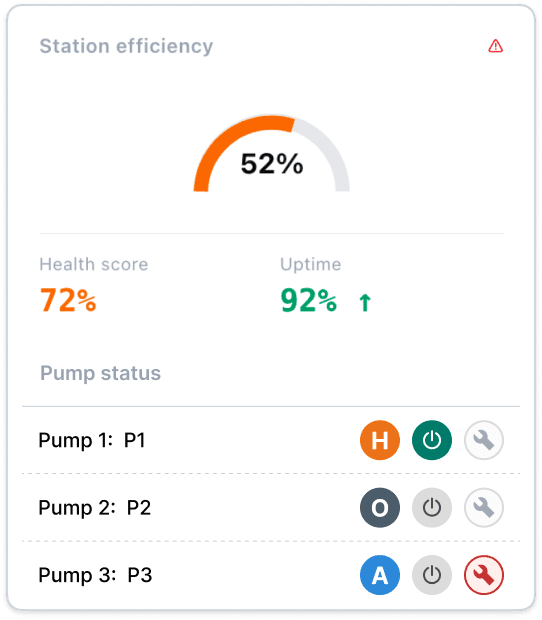
Health scoring
One number that means something, backed by the numbers that explain it.
Station efficiency, health score, and uptime sit together so an operator can see the summary and the detail in the same glance — the health score is never presented without what's driving it.
Predictive maintenance
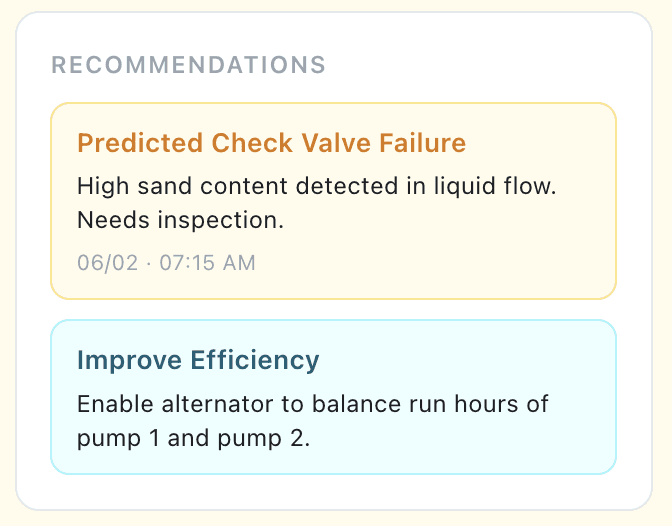
The twin tells you what's about to break, not just what already did.
Recommendations are generated from sensor patterns — high sand content, imbalanced pump run-hours — surfaced as specific, actionable cards instead of a generic warning light.
Simulation mode
Test a change on the twin before touching the real station.
Recommendations are generated from sensor patterns — high sand content, imbalanced pump run-hours — surfaced as specific, actionable cards instead of a generic warning light.

Alarm triage
Four alarms, sorted by how much they matter.
Critical, unresolved, and informational alarms are visually distinct at a glance — so an operator scanning quickly sees the one that needs action first, not just a flat list in the order they occurred.

04 - The design decision worth remembering
The hardest part of this project wasn't any single screen — it was making one interaction model work across four different twin types without it becoming four different products. Asset twins, system twins, process twins, and entity twins all needed the same underlying language: live state, historical playback, snapshot comparison, remote action — just scoped to a different unit each time.
Once the pattern was right at the asset level, scaling it to a system of assets, or a whole site, was a matter of composition — not reinvention.
05 - Outcome
4 asset types
Unified in one interaction model
92% uptime
Station uptime, up 8% month over month
1 framework
Reused across 5 verticals
NEXT PROJECT
HiddenQuest - Geocaching game for LoRa
View
IoT · Industrial
Asset Operations
Platform
Asset Platform — a pump station you can see, even from a thousand miles away.
Industrial pump stations run unattended, often in remote locations. Operators can't see the tank, the pumps, or the flow rate directly — they see numbers in a table, if they see anything at all. I designed the interaction model for Asset Platform's digital twin: a live, interactive visualisation of the physical station, fused with predictive maintenance recommendations.
Role
Interaction design, Prototyping, frontend implementation
Platform
Asset Operations Platform
Domain
Tank Level Monitoring, Water and Waste Water SCADA
Validated
Field usability testing
with operators
01 - The problem
A pump station runs unattended, often in a remote location, moving liquid through pumps that can fail without warning. The only way an operator traditionally knows something is wrong is a phone call after the fact — a flooded site, a dry tank, a burnt-out motor.
Asset Platform needed to turn a physical asset that's invisible from the office into something an operator could see, understand, and act on — in real time, without needing to be physically present.
02 - What the twin shows
The interaction model fuses live telemetry, historical playback, and predictive maintenance signals into one view — designed to answer three questions an operator always has: what's happening right now, what's likely to go wrong, and what should I do about it.
The twin isn't a dashboard of numbers. It's a live picture of the physical station, with the numbers attached to the parts they describe.
03 - Key screens
See the tank, not a table
Liquid level, pump status, and flow rate rendered as the physical station — not rows in a spreadsheet. An operator recognises a problem the same way they would standing in front of the real tank.
Live asset visual
Health scoring
One number that means something, backed by the numbers that explain it.
Station efficiency, health score, and uptime sit together so an operator can see the summary and the detail in the same glance — the health score is never presented without what's driving it.
Predictive maintenance
The twin tells you what's about to break, not just what already did.
Recommendations are generated from sensor patterns — high sand content, imbalanced pump run-hours — surfaced as specific, actionable cards instead of a generic warning light.
Simulation mode
Test a change on the twin before touching the real station.
Recommendations are generated from sensor patterns — high sand content, imbalanced pump run-hours — surfaced as specific, actionable cards instead of a generic warning light.
Alarm triage
Four alarms, sorted by how much they matter.
Critical, unresolved, and informational alarms are visually distinct at a glance — so an operator scanning quickly sees the one that needs action first, not just a flat list in the order they occurred.
04 - The design decision worth remembering
The hardest part of this project wasn't any single screen — it was making one interaction model work across four different twin types without it becoming four different products. Asset twins, system twins, process twins, and entity twins all needed the same underlying language: live state, historical playback, snapshot comparison, remote action — just scoped to a different unit each time.
Once the pattern was right at the asset level, scaling it to a system of assets, or a whole site, was a matter of composition — not reinvention.
05 - Outcome
4 asset types
Unified in one interaction model
92% uptime
Station uptime, up 8% month over month
1 framework
Reused across 5 verticals
NEXT PROJECT
HiddenQuest - Geocaching game for LoRa
View
IoT · Industrial
Asset Operations
Platform
Asset Platform — a pump station you can see, even from a thousand miles away.
Industrial pump stations run unattended, often in remote locations. Operators can't see the tank, the pumps, or the flow rate directly — they see numbers in a table, if they see anything at all. I designed the interaction model for Asset Platform's digital twin: a live, interactive visualisation of the physical station, fused with predictive maintenance recommendations.
Role
Interaction design, Prototyping, frontend implementation
Platform
Asset Operations Platform
Domain
Tank Level Monitoring, Water and Waste Water SCADA
Validated
Field usability testing
with operators
01 - The problem
A pump station runs unattended, often in a remote location, moving liquid through pumps that can fail without warning. The only way an operator traditionally knows something is wrong is a phone call after the fact — a flooded site, a dry tank, a burnt-out motor.
Asset Platform needed to turn a physical asset that's invisible from the office into something an operator could see, understand, and act on — in real time, without needing to be physically present.
02 - What the twin shows
The interaction model fuses live telemetry, historical playback, and predictive maintenance signals into one view — designed to answer three questions an operator always has: what's happening right now, what's likely to go wrong, and what should I do about it.
The twin isn't a dashboard of numbers. It's a live picture of the physical station, with the numbers attached to the parts they describe.
03 - Key screens
See the tank, not a table
Liquid level, pump status, and flow rate rendered as the physical station — not rows in a spreadsheet. An operator recognises a problem the same way they would standing in front of the real tank.
Live asset visual
Health scoring
One number that means something, backed by the numbers that explain it.
Station efficiency, health score, and uptime sit together so an operator can see the summary and the detail in the same glance — the health score is never presented without what's driving it.
Predictive maintenance
The twin tells you what's about to break, not just what already did.
Recommendations are generated from sensor patterns — high sand content, imbalanced pump run-hours — surfaced as specific, actionable cards instead of a generic warning light.
Simulation mode
Test a change on the twin before touching the real station.
Recommendations are generated from sensor patterns — high sand content, imbalanced pump run-hours — surfaced as specific, actionable cards instead of a generic warning light.
Alarm triage
Four alarms, sorted by how much they matter.
Critical, unresolved, and informational alarms are visually distinct at a glance — so an operator scanning quickly sees the one that needs action first, not just a flat list in the order they occurred.
04 - The design decision worth remembering
The hardest part of this project wasn't any single screen — it was making one interaction model work across four different twin types without it becoming four different products. Asset twins, system twins, process twins, and entity twins all needed the same underlying language: live state, historical playback, snapshot comparison, remote action — just scoped to a different unit each time.
Once the pattern was right at the asset level, scaling it to a system of assets, or a whole site, was a matter of composition — not reinvention.
05 - Outcome
4 asset types
Unified in one interaction model
92% uptime
Station uptime, up 8% month over month
1 framework
Reused across 5 verticals
NEXT PROJECT
HiddenQuest - Geocaching game for LoRa
View